Search doesn’t work the way it did two years ago. Not even close.
If your website traffic has been sliding and your leads have dried up, you’re not imagining it. And it’s probably not because your competitors suddenly got better at marketing.
It’s because Google fundamentally changed what happens when someone types in a search.
How Search Used to Work (For 20+ Years)
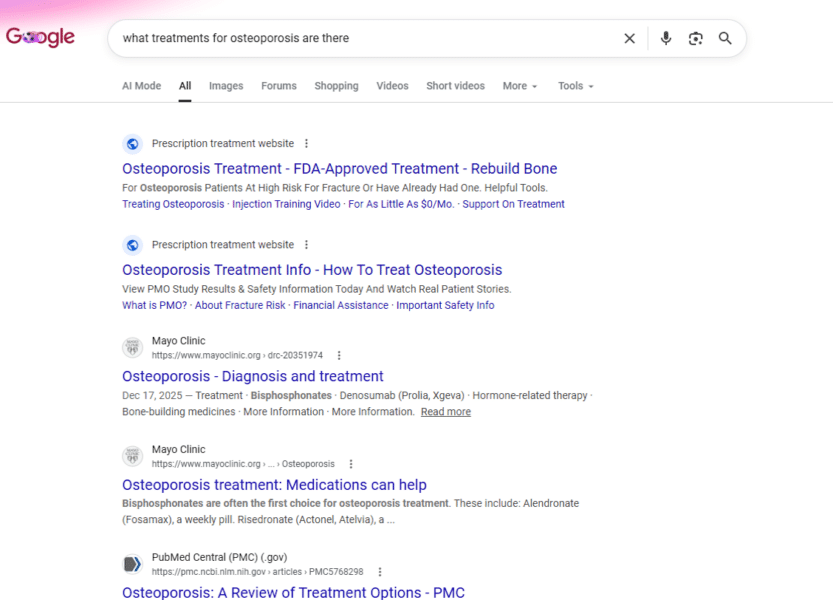
You typed a query. You got a couple of sponsored results, then a wall of blue links.
Then the real work started. You’d right-click a handful of results, open them in new tabs, skim each one, close the duds, go back to Google, refine your search, and repeat until you found what you needed.
That was the internet. For two decades, that back-and-forth research loop was how everyone found a plumber, compared products, or vetted a company.
That loop is gone.

What Search Looks Like Now
Run the same search today and you’ll still see a sponsored result or two. But right below it sits the AI Overview — and that changes everything.
Roughly 68% of searches now end without a single click to any website.
Here’s why. That research loop you used to do manually — opening tabs, comparing options, refining your search — Google now does automatically. When you hit enter, multiple AI agents fire off behind the scenes. They scour the web looking at reviews, service pages, competitor comparisons, and content that matches your intent and search history. Then they compress all of it into one answer at the top of the page.
This is also why bot traffic on the web now exceeds human traffic. One human search used to equal one session. Now one human search spawns a swarm of AI agents doing the legwork.
The searcher gets their answer without ever leaving Google. Your website never gets the click.
“But I Want People on My Website“
Fair. Every business owner says this.
Here’s the reframe: your traffic is down, but the leads that do come through are hotter than they’ve ever been.
By the time someone calls you or fills out your quote form, the AI Overview has already done the comparison shopping for them. It’s looked at you, your competitors, your services, and your reviews — and presented you as the answer. The tire-kicking happened before they ever touched your site.
Fewer visitors. Better buyers. That’s the trade — if you’re the business the AI cites. Which brings us to the real question.
Old SEO vs. AI-Optimized Content: A Real Example
You’ve seen old-school SEO pages. We all have.

Say a plumber wanted to rank for “emergency plumber Miami.” The old playbook was to stuff that exact phrase into every paragraph, every heading, every image tag. The page technically existed, but it said nothing. Readers landed, went meh, and left. It was written for a search algorithm, not a person.
That approach is dead. Worse than dead — it actively signals low quality to AI systems.
Compare that to a page we’re building right now for a local plumbing client, targeting water heater replacement in Fond du Lac and eastern Wisconsin. It answers a question homeowners actually ask:

Why do water heaters die after seven years in Wisconsin?
Because Wisconsin has brutally hard water. The minerals build up, sediment collects, and tanks fail years earlier than the manufacturer’s estimate.
The page explains that. It covers what units the company installs and why. It includes a maintenance tip straight from the owner — the kind of thing you only know after decades in the trade. It even tells you exactly what to expect when you call: who answers, what happens next, how the quote works.
“Authoritative content from experts (like most business owners) who’ have years of experience and expertise is what it takes to rank now.”
Vincent Wondra, Founder, The BBS Agency
Google’s AI reads a page like that and understands exactly what this company does, where they do it, and why they’re credible. That’s the content AI Overviews pull from and cite.
5 Things Every AI-Optimized Page Needs in 2026
- A real question as the frame. Not a keyword. A question your customer actually asks — “Why does my water heater keep failing?” — answered directly in the first few sentences.
- Local specificity. Hard water in Wisconsin. Freeze-thaw cycles. Regional code requirements. Generic content gets ignored; local expertise gets cited.
- First-hand expertise, visibly. A tip from the owner. A note about what you install and why. AI systems weigh demonstrated experience heavily — and so do humans.
- A “what to expect” section. Walk people through what happens when they call. It builds trust with readers and gives AI clean, structured facts about your process.
- Content written for humans first. This is the twist. When you write clearly for a person, you’re also making it easy for AI crawlers to understand your services. The two goals used to conflict. Now they’re the same goal.
Frequently Asked Questions
What is an AI Overview?
It’s the AI-generated answer box at the top of Google search results. It synthesizes information from multiple websites into a direct answer, often including citations to the sources it pulled from. Getting cited there is the new “ranking #1.”
Why is my website traffic down even though my rankings look fine?
Because ranking and clicks have decoupled. You can hold a top position and still lose traffic if the AI Overview answers the question before anyone scrolls to the links. Around 68% of searches now end with zero clicks.
Does traditional SEO still matter?
The fundamentals do — site speed, structure, authority, local signals. But keyword-stuffed pages built purely “for Google” now work against you. The content itself has to demonstrate real expertise, or AI systems skip right over it.
How do I get my business cited in AI Overviews?
Publish genuinely useful, specific, experience-backed content about the services you offer and the area you serve. Answer real customer questions directly. Make your process transparent. The businesses AI cites are the ones whose pages actually explain things well.
Is this only a problem for big companies?
The opposite. Local service businesses — plumbers, electricians, HVAC, contractors, accountants, lawyers — have the biggest opportunity here, because AI Overviews favor specific local expertise over generic national content.
The Bottom Line
We used to write pages to be optimized for Google. Now we write pages for humans — and in doing that, we make them easy for AI to understand, trust, and cite.
If your traffic has slipped and your phone has gone quiet, your content is probably still playing by the old rules.